
The rapid evolution of biosimilar regulation over the past decade is reflected in EMA’s Concept paper proposing a revision of the Guideline on Similar Biological Medicinal Products, which was last revised in 2015. EMA states that the revision is needed because “major progress has been made in the analytical sciences and regulatory field of biosimilars” since the previous update. The concept paper highlights the tailored clinical approach to biosimilar development, the ongoing ICH M18 work on comparative efficacy studies, upcoming changes in the European pharmaceutical legislation, and the growing regulatory experience with biosimilar marketing authorisation applications.
This proposal captures a broader transformation in the biosimilar field. Since 2015, biosimilars have matured scientifically and are now an established part of modern healthcare. The central development has been the increasing confidence that biosimilarity can often be demonstrated primarily through detailed structural and functional comparability, rather than through large comparative efficacy studies.
The biosimilar landscape in 2015
By 2015, Europe had already gained almost a decade of experience since the approval of the first EU biosimilar, Omnitrope, in 2006. Nevertheless, regulatory experience continued to develop for more complex classes of biological products, including monoclonal antibodies. Biosimilar development therefore often included substantial non-clinical and clinical programmes to confirm similarity to the originator.
The basic regulatory principle was, however, already clear: a biosimilar must be highly similar to an approved reference biological medicine, with no clinically meaningful differences in quality, safety, efficacy, or immunogenicity. Unlike generics, biosimilars cannot be identical copies, because biological medicines are produced in living systems and have inherent molecular variability. This makes the comparability exercise central to biosimilar development.
Progress in analytical sciences
A significant scientific advance since 2015 has been the development of increasingly powerful analytical technologies and their growing acceptance by regulatory authorities. Modern methods can characterise biological medicines in great detail, including critical quality attributes such as primary and higher-order structure, glycosylation patterns, impurities, aggregation, receptor binding, and biological activity.
These advances have shifted biosimilar development towards an analytical-driven approach. A robust analytical comparability package can often be more sensitive than a clinical efficacy study in identifying relevant differences between a biosimilar and its reference product. As a result, clinical studies are increasingly used to address any remaining uncertainty rather than to reconfirm efficacy
Originator versus biosimilar: The inverted pyramid
The shift in development philosophy is often illustrated by the “inverted pyramid” model. For an originator biological medicine, the largest development effort is typically placed on clinical studies, because the product’s safety, efficacy, and potency must be established for the first time. For a biosimilar, the objective is different: the developer must demonstrate biosimilarity to an already approved reference product. Therefore, the largest part of the evidence package is analytical characterisation and structure-function assessment.
This model highlights a key regulatory principle: the better the understanding of the product’s molecular structure, biological function, and critical quality attributes, the less uncertainty remains for non-clinical and clinical performance. Over the last decade, advances in analytical science have allowed regulators to place greater weight on this evidence, making development more efficient while maintaining the same standards for quality, safety, and efficacy.
Comparison of data requirements
The difference between originator and biosimilar development is also reflected in the regulatory data requirements. An originator biological medicine requires a full development package to independently establish benefit-risk. A biosimilar instead relies on the existing knowledge of the reference medicine and must demonstrate, through comprehensive comparability studies, that the product is highly similar and has no clinically meaningful differences in safety, quality, or efficacy.
Accordingly, comparative quality studies form the foundation of the biosimilar package, supported by targeted comparative non-clinical and clinical studies where needed. EMA states that this approach allows avoidance of unnecessary repetition of clinical trials already performed with the reference medicine
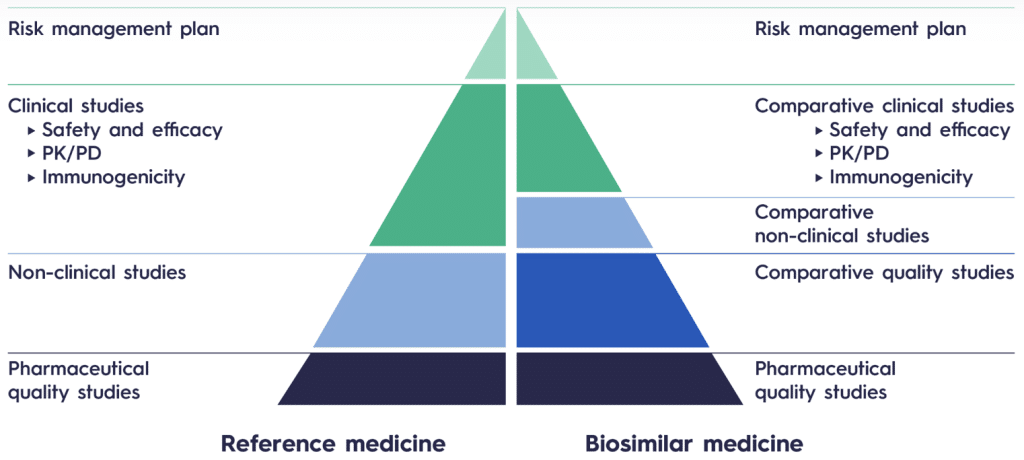
Source: EMA Biosimilar Medicines Overview.
Regulatory maturity and market development
Regulators have also gained substantial practical experience in assessing biosimilars across different product classes. This has strengthened confidence in extrapolation of indications, tailored non-clinical programmes, and reduced clinical requirements where scientifically justified. EMA’s Reflection paper on a tailored clinical approach in biosimilar development specifically aims to reduce the amount of clinical data required to develop and approve biosimilar medicines.
The regulatory evolution has occurred in parallel with a maturing market. Biosimilars are now widely recognised as a mechanism to increase competition, improve patient access to biological medicines, and support healthcare system sustainability. EMA states that biosimilar competition should improve patient access to safe and effective biological medicines with proven quality.
Biosimilar development going forward
The upcoming revision of EMA’s biosimilar guideline highlights how far the field has progressed since 2015. Today’s biosimilar development relies primarily on robust analytical comparability data, supported by targeted non-clinical and clinical studies where needed. With continued advances in analytical science and increasing international regulatory alignment, biosimilars are well positioned to become an even more important component of future healthcare.

Erik Hedner
PhD, Head of Regulatory Affairs & CMC
How do these changes affect you?
Our experienced specialists are ready to help you navigate the regulatory landscape!